Year
2025
Role
Benchmarking methodology, profiling, analysis
Stack
- TensorRT
- ONNX Runtime
- TorchScript
- torch.compile
- Nsight
- CUDA
Systems performance
Optimization for AI Inference Engines on GPUs
A systematic study of GPU inference optimisation across ResNet50 and DistilBERT — FP16, INT8 quantisation, TorchScript, torch.compile and ONNX — measured rather than assumed.
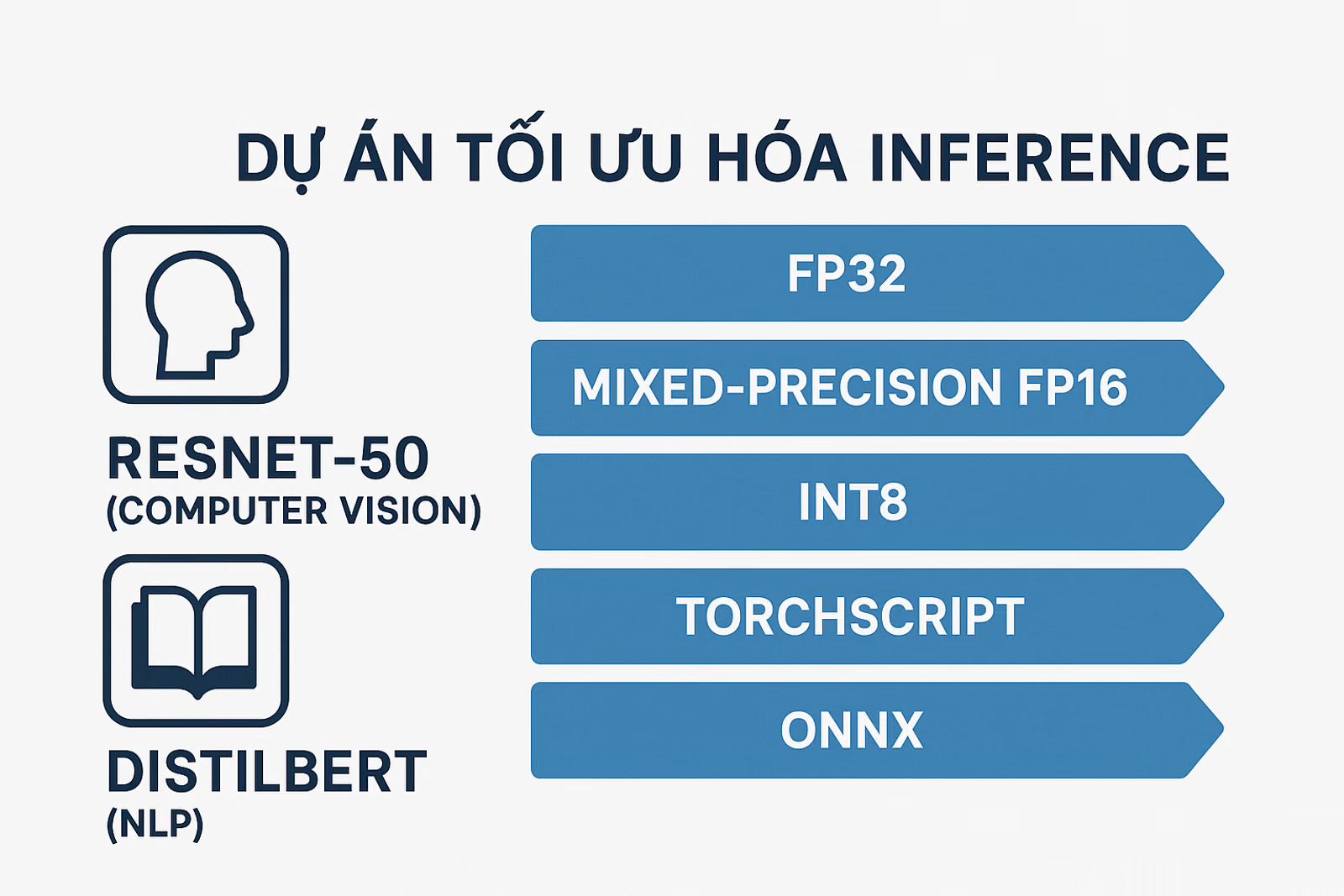
- The project focuses on optimizing AI inference on GPUs for ResNet50 and DistilBERT through FP16, INT8, TorchScript/torch.compile, and ONNX.
- Results show that FP16 provides significant improvement, especially for DistilBERT: throughput increased from 305 → 1202 samples/s at batch size 8 (≈4×).
- INT8 (TensorRT) achieves 2–5× speedup but requires careful calibration to maintain accuracy.
- Graph optimization yields a 1.2–1.8× speedup, while CUDA profiling identifies the main bottlenecks in GEMM and ReLU kernels.
- The project demonstrates that mixed-precision and quantization are the most effective approaches for large-scale inference optimization.
- FP16 throughput
- 4×
- DistilBERT
- INT8 speedup
- 2–5×
- TensorRT
- Graph optimisation
- 1.2–1.8×
The problem
Training gets the attention; inference gets the bill. A model served in production runs its forward pass millions of times, and the gap between a naive PyTorch .eval() loop and a properly optimised engine is often close to an order of magnitude.
I benchmarked the optimisation techniques across two deliberately different workloads — ResNet50 (convolutional, vision) and DistilBERT (transformer, language) — because the techniques do not transfer evenly between them, and a single-model benchmark hides exactly that.
What was measured
Mixed precision (FP16) was the largest single win, and disproportionately so for DistilBERT: throughput rose from 305 to 1202 samples/s at batch size 8 — roughly 4×. Transformer inference is dominated by large dense GEMMs, which map directly onto tensor cores; halving the precision halves memory traffic and roughly doubles arithmetic throughput at once. ResNet50 improved too, but by less — convolutions were already well served.
INT8 via TensorRT delivered 2–5×, the widest range in the study, and the most conditional. INT8 needs a calibration pass to fit activation ranges, and a poorly chosen calibration set costs accuracy that no amount of speed justifies. The speedup is real; it is not free.
Graph optimisation — TorchScript, torch.compile, ONNX export — gave a consistent 1.2–1.8× through operator fusion and the removal of Python dispatch overhead. Smaller than precision reduction, but it composes with it and costs nothing in accuracy.
CUDA profiling located the bottlenecks in GEMM and ReLU kernels — which is the sanity check on all of the above. GEMM dominance is what makes precision reduction the highest-leverage move; had the profile been memory-bound elsewhere, the ranking would have inverted.
Conclusion
For large-scale inference, mixed precision and quantisation dominate. Graph-level optimisation is worth doing and worth stacking, but it is a multiplier on a smaller base.
What I took from it
The profiler settles arguments that intuition loses. Knowing that GEMM and ReLU own the runtime tells you immediately which optimisations can possibly matter — and stops you from spending a week on one that mathematically cannot.