Year
2024
Role
Full implementation — dataset, loss function, attention module, training
Stack
- PyTorch
- YOLOv1
- CBAM
- ReduceLROnPlateau
Architecture study
YOLOv1 With CBAM From Scratch
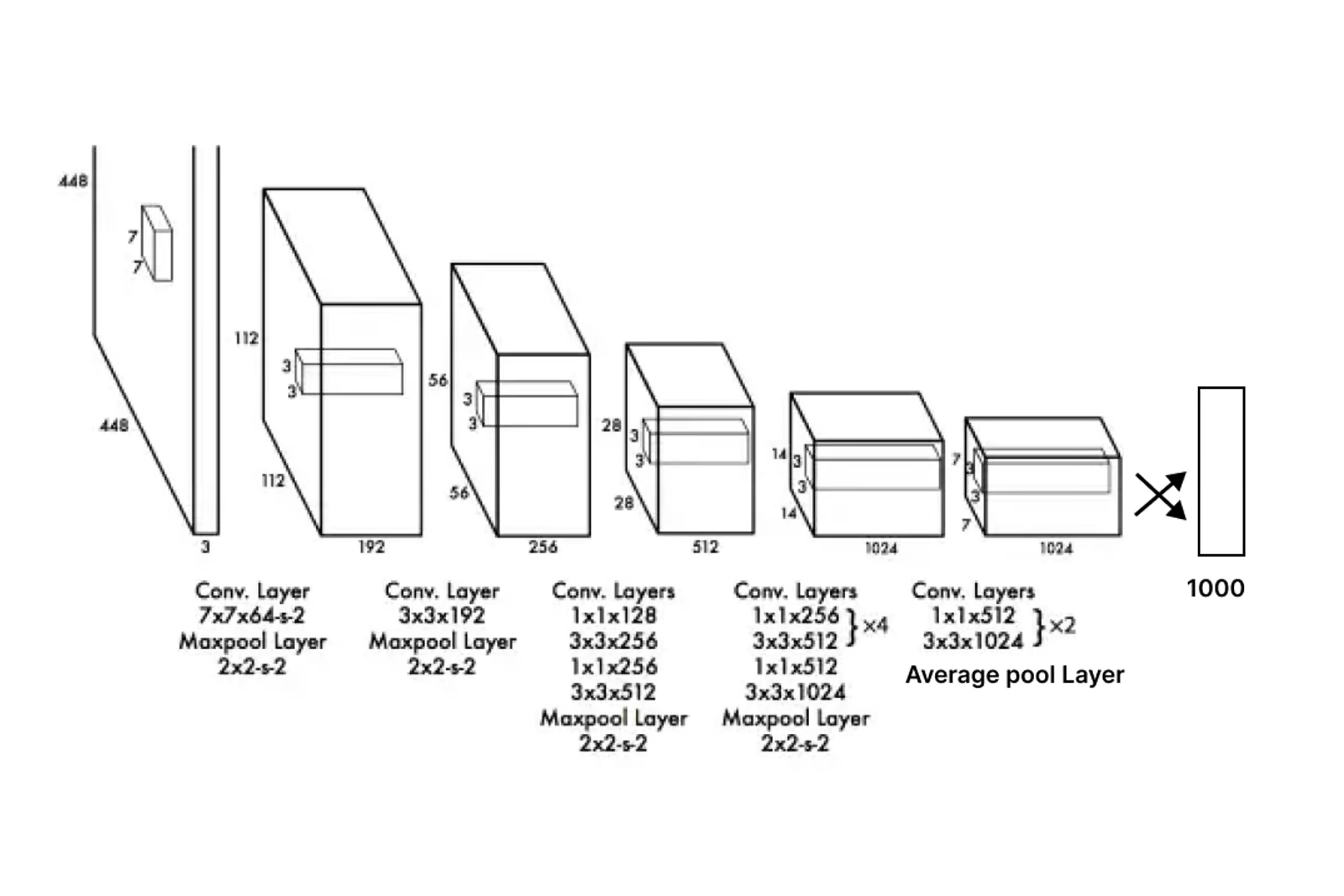
A ground-up PyTorch reimplementation of YOLOv1 — custom dataset, custom loss — extended with CBAM attention to measure what attention contributes to a one-stage detector.
- This project rebuilt the YOLOv1 model from scratch using PyTorch, where I implemented FruitDataset and YoloLoss, and integrated CBAM (Convolutional Block Attention Module) to enhance feature extraction, with a total of 269,168,434 parameters.
- The model employed the ReduceLROnPlateau scheduler to optimize the training process.
- Training results showed a Train mAP of 0.8829 and a Best Validation mAP of 0.6994.
- These results demonstrate that CBAM provides significant improvements in object detection performance.
- Train mAP
- 0.8829
- Best val mAP
- 0.6994
- Parameters
- 269.2M
The goal
Reimplement YOLOv1 from the paper rather than clone a repository, then use that implementation as a controlled testbed for a single question: what does channel-and-spatial attention buy a one-stage detector?
Building it from scratch is what makes the answer trustworthy. In a codebase I did not write, an ablation measures the difference between two configurations I do not fully understand.
What I implemented
FruitDataset— image loading, augmentation, and the encoding that turns bounding boxes into YOLO'sS × S × (B·5 + C)grid target. This encoding is the fiddliest part of YOLO and the place where a subtle bug produces a model that trains without ever converging.YoloLoss— the multi-part objective: coordinate regression, confidence for cells containing an object, confidence for cells that do not, and classification. Theλ_coordandλ_noobjweights exist because the overwhelming majority of grid cells are empty; without down-weighting them, the no-object term drowns everything else.- CBAM — the Convolutional Block Attention Module, applying channel attention (which feature maps matter) then spatial attention (where in the map matters) in sequence.
269,168,434 parameters total. Training used ReduceLROnPlateau, dropping the learning rate when validation stopped improving.
Results
Train mAP 0.8829, best validation mAP 0.6994.
CBAM improved detection performance meaningfully — the attention modules help the network suppress background and concentrate on object regions, which is precisely the failure mode a grid-based one-stage detector suffers from.
The 0.18 train/validation gap is the other honest reading of these numbers: this is a 269M-parameter model, and a gap that size says it has capacity to spare relative to the dataset. On a larger corpus the validation figure would be the one that moves.
What I took from it
Writing the loss function by hand taught me more about YOLO than reading the paper did. The λ_noobj weight is a single line, and it encodes the central structural problem of one-stage detection — a fact that is invisible until you have to choose the number yourself.